
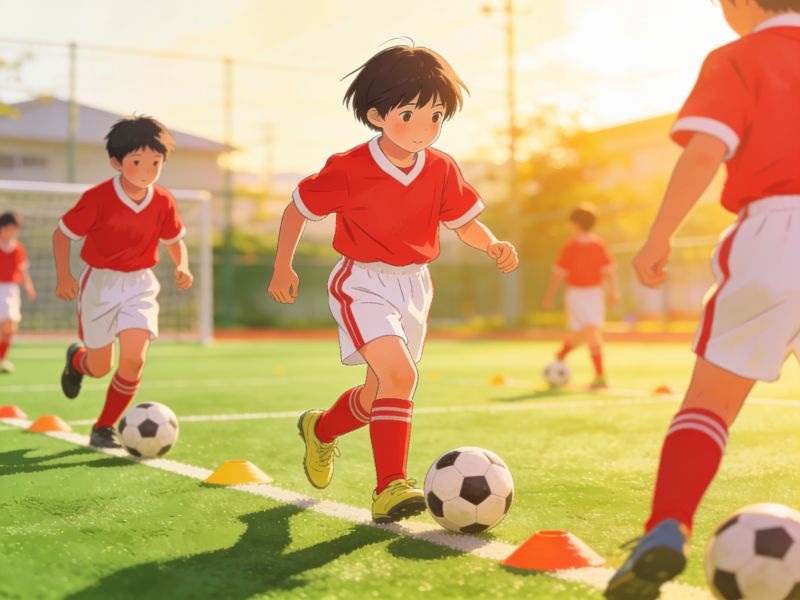
Japanese elementary school soccer doesn't produce highlight-reel superstars at age ten. It produces kids who can trap a ball under pressure, scan for a pass before receiving, and bow to the referee after a loss. I spent three months watching practices at a public school in Saitama, and the contrast with youth soccer cultures I'd seen elsewhere was stark. No parents screaming from the sideline. No trophies handed out after a Saturday tournament. Just twenty-eight third-graders rotating through a circuit of cone dribbling, two-touch passing, and a small-sided game where the coach stops play every ninety seconds to ask。"Where was your head?" The emphasis is cognitive, not physical—decision-making before athleticism.The structure of Japanese elementary school soccer reflects a broader educational philosophy. Most school teams practice twice a week for ninety minutes, and matches are fewer than ten per year. Coaches—often classroom teachers with a coaching license, not ex-professional players—follow a national curriculum that prioritizes ball mastery and spatial awareness over tactics or results. In one drill I watched, a teacher placed four gates on a 20x20 meter grid and told players to dribble through as many gates as possible in two minutes. No score, no winner. The point was scanning. "They learn to look before they move," the teacher told me. "If they only look at the ball。they'll never see the pass." This approach to Japanese elementary school soccer deliberately delays competitive specialization.What struck me most was the ritual of reflection. After every practice, players sit in a circle and share one thing they did well and one thing they'll try next time. A shy second-grader said。"I didn't panic when the ball came to me." Another admitted, "I forgot to call for the pass." The coach nodded, offered no praise or criticism, and moved on. This isn't performative humility—it's a habit of self-assessment built into Japanese elementary school soccer from the start. I've seen youth programs elsewhere where post-game talks are coach-led monologues about effort and attitude. Here, the kids do the talking. That difference matters. By age nine, they're already developing a vocabulary for their own play, which makes them more coachable later.Competition exists, but it's contained. Saitama's city-wide elementary school soccer festival draws forty schools。
yet matches are six-a-side on small pitches with no offside rule and mandatory substitutions every ten minutes. Every player on the roster plays at least half the game. I watched a quarterfinal where the score ended 1-1, and both coaches agreed to skip extra time so the kids could catch their bus. Nobody complained. The priority is participation volume, not knockout drama. That said, the soccer isn't soft. Tackles are real, and the best players—usually the ones who've played since first grade—dominate possession. The difference is that the system doesn't amplify that dominance into a win-at-all-costs culture. Standout players are expected to bring teammates into the game, not carry the team alone.Two limitations are worth naming. First, Japanese elementary school soccer is heavily dependent on volunteer coaches, and quality varies by school district. Wealthier areas with more stay-at-home parents field stronger teams. Second。
the lack of games means late bloomers—kids who develop physically later—often get overlooked when middle school club selection begins. I watched a fourth-grader with excellent positioning but average speed get passed over for a faster, less tactically aware peer. The coach shrugged: "We need results in middle school." That tension between the elementary philosophy of broad development and the middle school reality of competitive selection is unresolved. Still, the foundation is sound. Kids leave elementary school soccer knowing how to scan, how to reflect, and how to play without fear of mistakes. That's more than most youth systems can claim.